Dactylioceras commune
UNB-2018-0741Fossils » Eukaryote » Animalia » Mollusca » Cephalopoda » Ammonoidea
Description
Kingdom: Animalia
Phylum: Mollusca
Class: Cephalopoda
Subclass: Ammonoidea
Order: Ammonitida
Family: Dactylioceratidae
Genus: Dactylioceras (Hyatt, 1867)
Species: Dactylioceras commune (Sowerby, 1815)
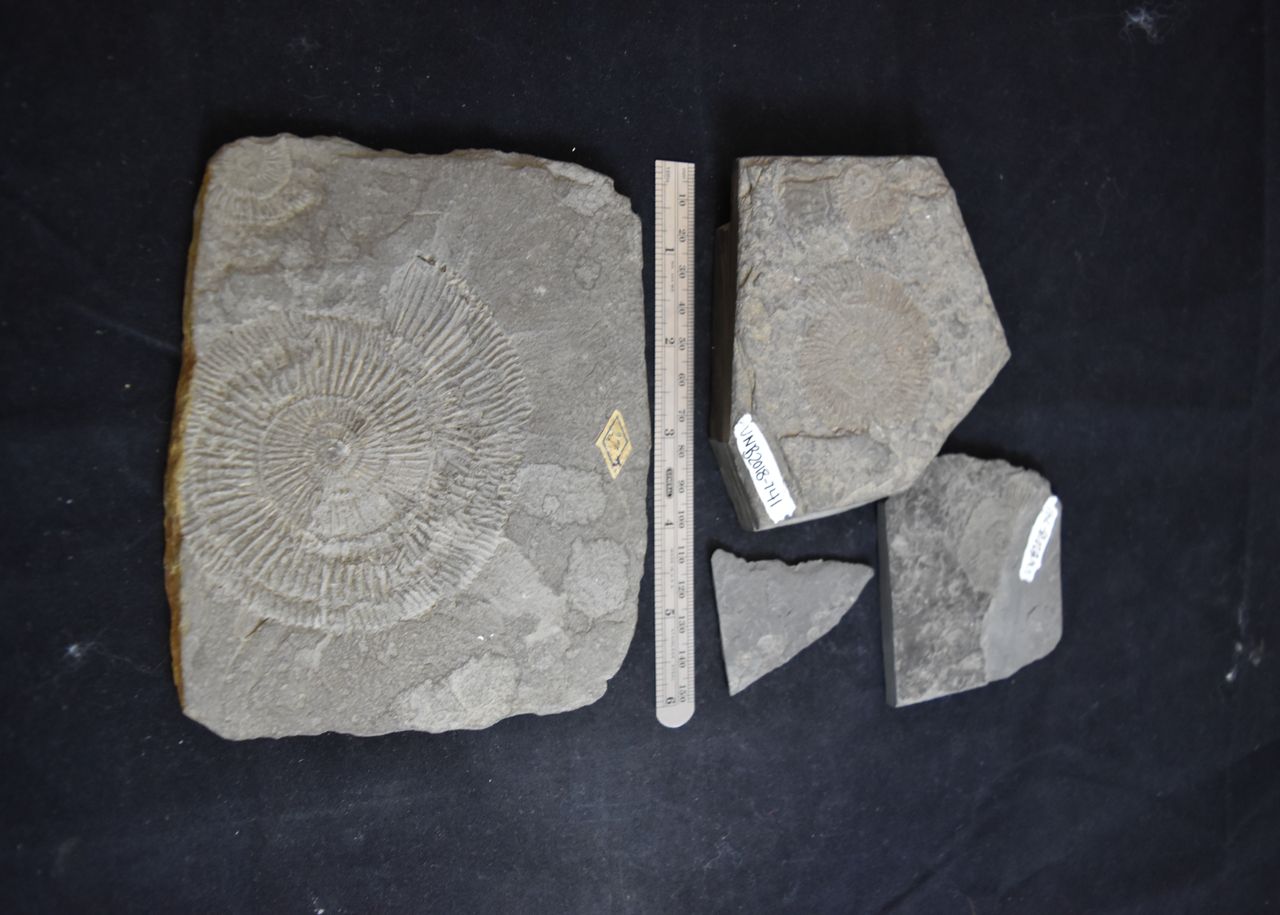
Four samples of limestone with various mold of Dactylioceras commune on the different samples. The larger sample of limestone has a large serpenticone specimen with six whorls. Umbilicus is visible. Prominent, bifurcating ribs.
The second largest limestone sample has two molds of Dactylioceras commune; One complete specimen with five whorls and one partial specimen near the margin of the sediment with four visible whorls. Umbilicus is visible on both specimens. Prominent bifurcating ribs.
The second smallest specimen has a partial specimen with part of the outer whorl missing near the aperture. Prominent, thin bifurcating ribs.
The smallest specimen has several small specimens with weathered ribs.
Specifications
| Object name | Dactylioceras commune |
|---|---|
| ID | UNB-2018-0741 |
| Legal status | Permanent collection |
| Category | Fossil |
| Classification | Domain: Eukaryote Kingdom: Animalia Phylum: Mollusca Class: Cephalopoda Subclass: Ammonoidea |
| Composition | Limestone |
| Age | Eon: Phanerozoic Era: Mesozoic Period: Jurassic Epoch: Lower Jurassic Age: Hettangian |
| Numeric age | 201.3 Mya |
| Origin | Holzmaden, Baden-Wurttemberg, Germany |
| Pieces | 4 |
| Partial | No |
| Measurements |
|
Map of Origin
Publications
- J. Sowerby. 1815. The mineral conchology of Great Britain; or colored figures and descriptions of those remains of testaceous animals or shells, which have been preserved at various times and depths in the Earth. Parts IXX to XX. The mineral conchology of Great Britain 2(19-20):1-28