Cranaena sp.
UNB-2018-0225Fossils » Eukaryote » Animalia » Brachiopoda » Rhynchonellata
Description
Kingdom: Animalia
Phylum: Brachiopoda
Class: Rhynchonellata
Order: Terebratuilda
Family: Cranaenidae
Genus: Cranaena (Hall and Clarke, 1893)
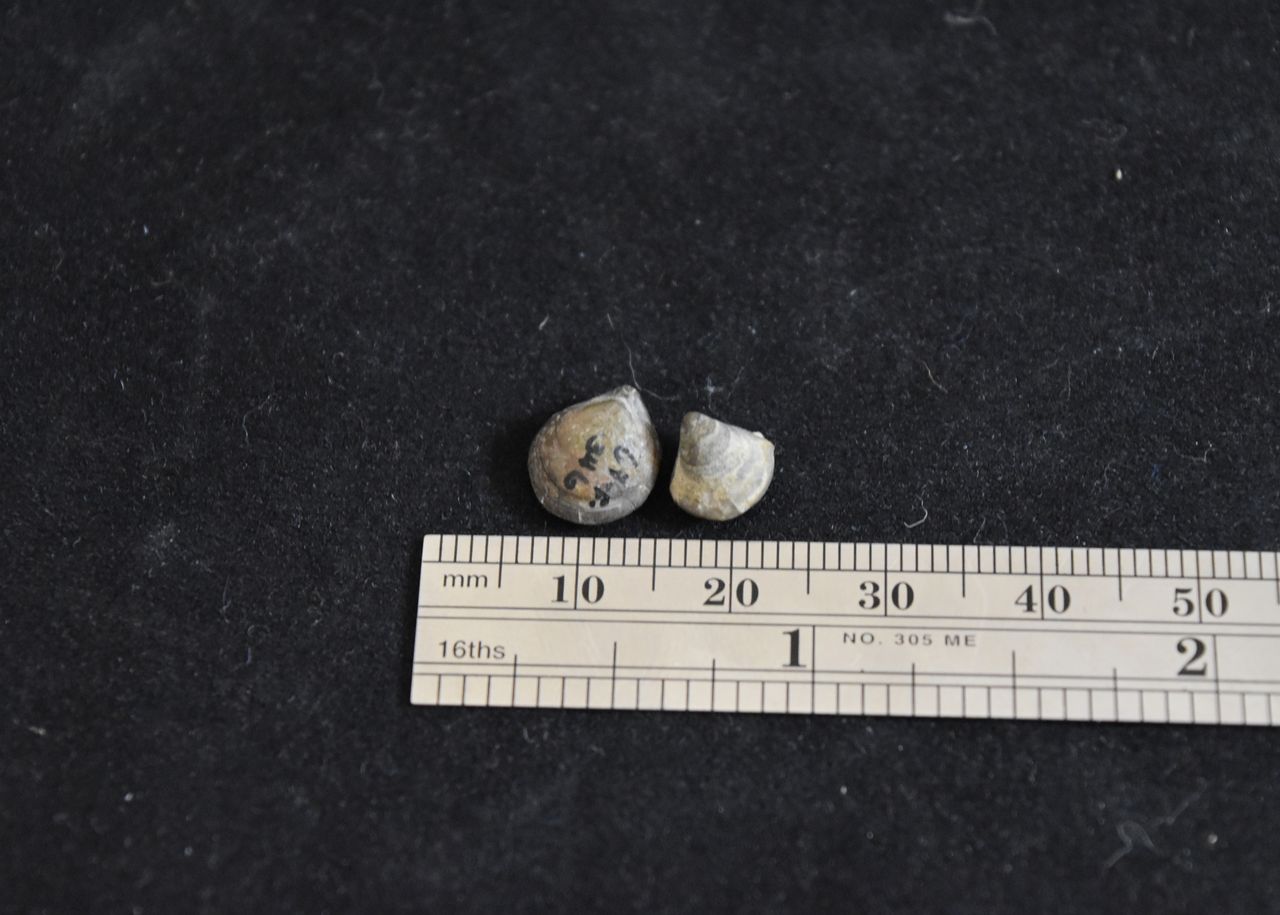
Two small specimens with both the brachial and pedicle valves preserved. Both specimens appear to be different species, with the largest specimen belonging to the genus Cranaena. The largest specimen is more circular in appearance compared to the smaller specimen which is more triangular towards the posterior margin. No visible ribs but faint growth lines are visible. The larger specimen has a notably larger pedicle valve compared to the brachial valve. The larger specimen appears more flat while the smaller specimen appears more biconvex.
Specifications
| Object name | Cranaena sp. |
|---|---|
| ID | UNB-2018-0225 |
| Legal status | Permanent collection |
| Category | Fossil |
| Classification | Domain: Eukaryote Kingdom: Animalia Phylum: Brachiopoda Class: Rhynchonellata |
| Composition | Calcium carbonate |
| Age | Eon: Phanerozoic Era: Paleozoic Period: Devonian Epoch: Middle Devonian to Upper Devonian Age: Eifelian to Famennian |
| Numeric age | 393.3 - 372.2 Mya |
| Origin | Erie County, New York, U.S.A. |
| Pieces | 2 |
| Partial | No |
| Measurements |
|
Map of Origin
Publications
- T. W. Amsden. 1983. The Late Ordovician brachiopod genera Lepidocyclus and Hiscobeccus. Oklahoma Geological Survey Bulletin 132:36-44
- T. A. Conrad. 1842. Observations on the Silurian and Devonian systems of the United States, with descriptions of new organic remains. Journal of the Academy of Natural Sciences of Philadelphia 8(2):228-280T. A. Conrad. 1842. Observations on the Silurian and Devonian systems of the United States, with descriptions of new organic remains. Journal of the Academy of Natural Sciences of Philadelphia 8(2):228-280