Pyrite, Chalcopyrite and Siderite
UNB-2018-0052Minerals » Sulphides
Description
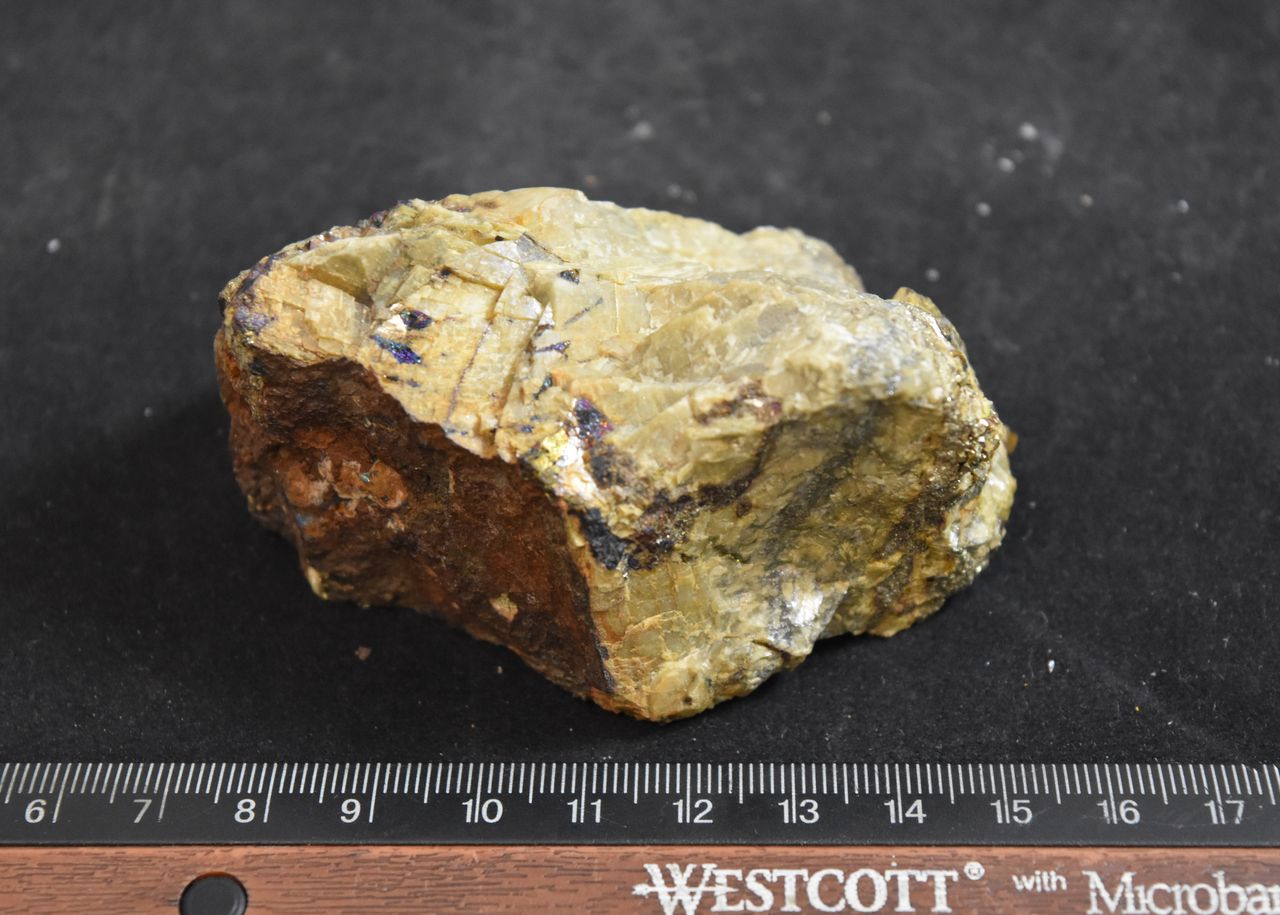
Sample of light brown compact Siderite with a vitreous lustre with tarnished blue/purple Chalcopyrite and small euhedral pyritohedrons of brass-yellow Pyrite.
Pyrite (FeS2) can be pale yellow or brass-yellow that is often tarnished brown or iridescent. Lustre is metallic and streak is greenish black. Hardness is 6 to 6 1/2. Pyrite usually occurs as cubes or pyritohedrons with parallel striations on crystal faces. Pyrite can also occur as octahedrons, nodules, fine to coarse granular or fibrous.
Siderite (FeCO3) can be light to dark brown, reddish brown or white. Lustre is vitreous, pearly or dull. Streak is white or pale yellow and hardness is 3 1/2 to 4. Cleavage is perfect in three directions forming a rhombohedron. Siderite usually occurs as rhombohedral with curved faces but can also be prismatic, scalenohedral, granular, cleavable masses, compact, massive, botryoidal or fibrous.
Chalcopyrite (CuFeS2) can be brass-yellow or golden-yellow that can be tarnished iridescent or a deep blue, purple or black. Lustre is metallic and streak is greenish black. Hardness is 3 1/2 to 4 and cleavage is poor in one direction. Chalcopyrite usually occurs as tetrahedral with uneven crystal faces that can have striations. Chalcopyrite can also occur as massive, compact, granular or disseminated.
Specifications
| Object name | Pyrite, Chalcopyrite and Siderite |
|---|---|
| ID | UNB-2018-0052 |
| Legal status | Permanent collection |
| Category | Mineral |
| Classification | Mineral group: Sulphides |
| Composition |
|
| Origin | Huayllay, Pasco, Peru |
| Pieces | 1 |
| Partial | No |
| Measurements |
|
Map of Origin
Publications
- Chesterman, C.W. 1979. Audubon Society, Field Guide to North American Rocks and Minerals. Knopf.