Calcite and Sphalerite
UNB-2018-0026Minerals » Carbonates
Description
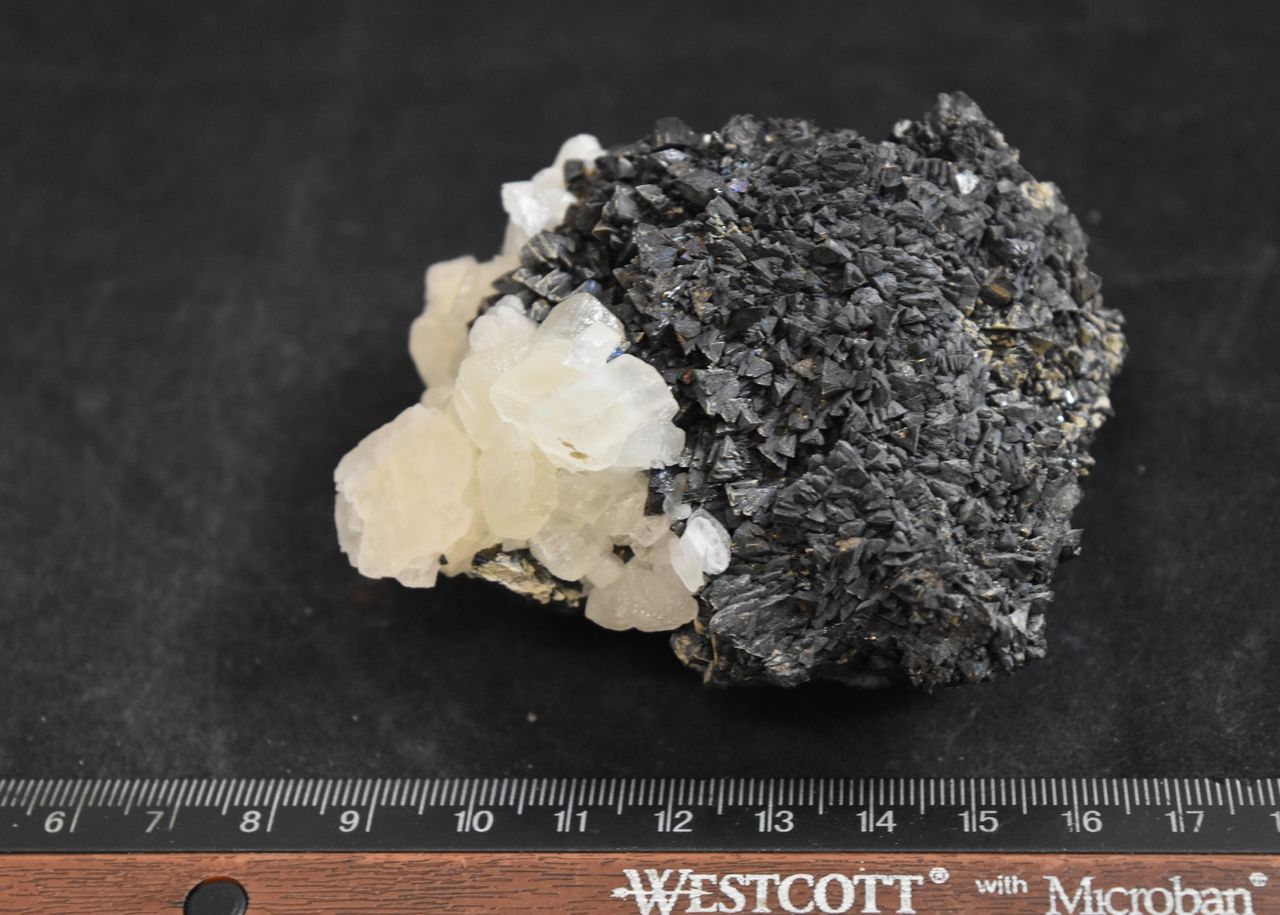
Sample of white euhedral rhombohedron Calcite crystals with a dull lustre entwined with black euhedral tetrahedral Sphalerite crystals with a resinous lustre. Average Calcite crystal size: 1.0 cm x 1.1 cm x 0.9 cm. Average Sphalerite crystal size: 0.3 cm x 0.2 cm x 0.2 cm.
Calcite (CaCO3) can be white, colourless or pale shades of grey, yellow, red, green, blue or brown and black when impure. Lustre is vitreous or dull and streak is white. Hardness is 3 and cleavage is perfect in three directions forming a rhombohedron. Calcite usually occurs as rhombohedron, scalenohedron and prisms but can also be tabular, acicular, cleavable, granular, compact, stalacitic, oolitic or earthy.
Sphalerite (ZnS) can be yellow, brown, red, green, black, white (rare) or grey (Cleiophane). Lustre can be resinous, adamantine or submetallic and streak is light brown and will always be lighter than the sample. Hardness is 3 1/2 to 4 and cleavage is perfect in six directions. Sphalerite usually occurs as tetrahedral or dodecahedral with rounded faces but can also be cleavage masses, granular, compact or botryoidal.
Specifications
| Object name | Calcite and Sphalerite |
|---|---|
| ID | UNB-2018-0026 |
| Legal status | Permanent collection |
| Category | Mineral |
| Classification | Mineral group: Carbonates |
| Composition |
|
| Origin | Unknown |
| Pieces | 1 |
| Partial | No |
| Measurements |
|
Publications
- Chesterman, C.W. 1979. Audubon Society, Field Guide to North American Rocks and Minerals. Knopf.