Rutile and Hematite
UNB-2017-0248Minerals » Oxides
Description
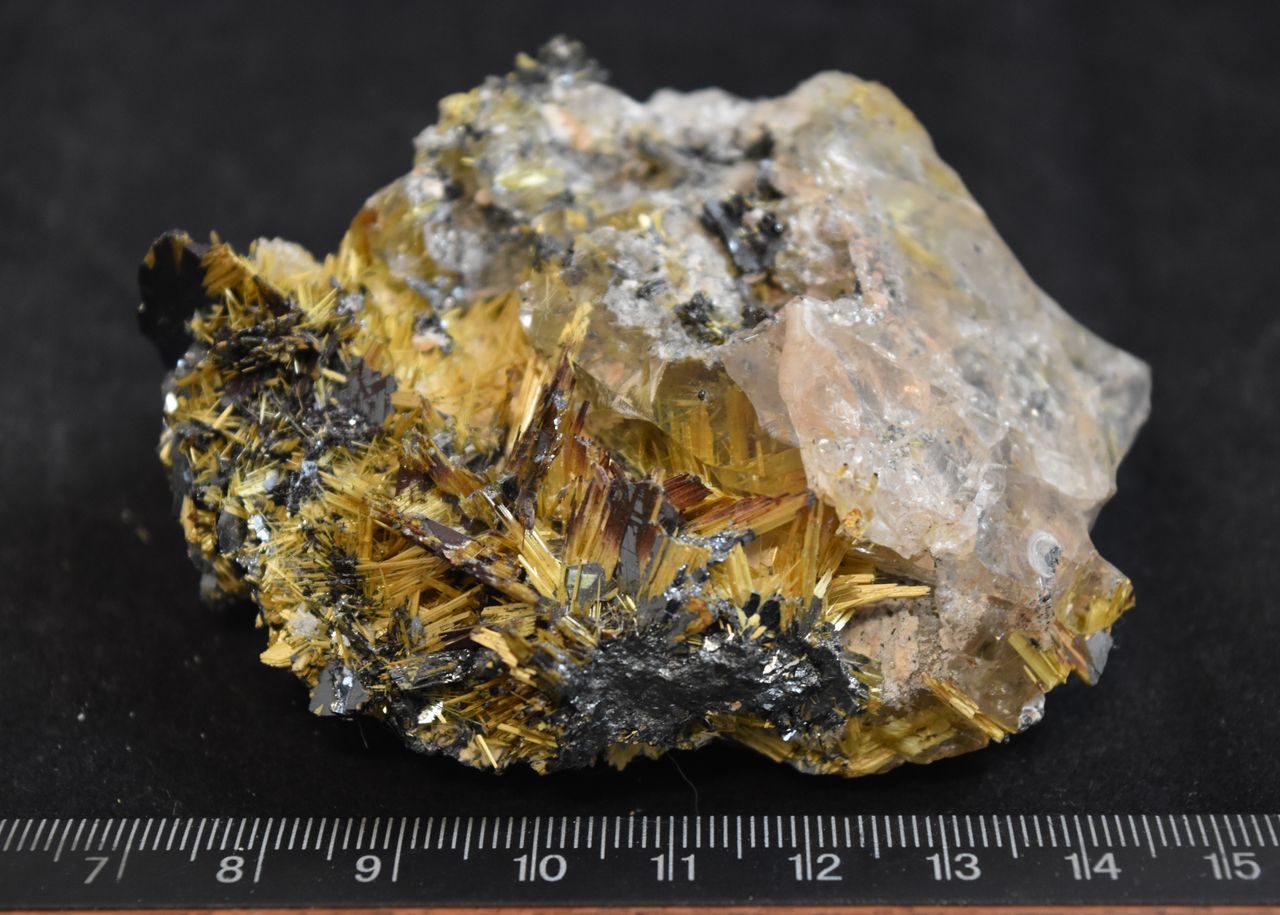
Sample of yellow/brown acicular Rutile with an adamantine lustre. The Rutile crystals are entwined with lead-grey subhedral Hematite crystals that have a submetallic lustre. Largest Hematite crystal size: 1.6 cm x 0.6 cm x 0.1 cm.
Rutile (TiO2) can be red, reddish brown, brownish-yellow or black and has an adamantine to submetallic lustre. Streak is white, grey or pale brown and hardness is 6 to 6 1/2. Cleavage is distinct, sometimes good in two directions and poor in the third. Rutile usually occurs as long, striated prismatic crystals but can also be knee-shaped and rosette twins or acicular, compact and disseminated.
Hematite (Fe2O3) can be steel-grey, red, reddish brown or black and has a metallic lustre. Streak is dark red, cherry-red or brownish red and hardness is 5 to 6. Hematite can be thick to thin tabular crystals but can also be compact, granular, radiated, reniform, botryoidal or earthy.
Specifications
| Object name | Rutile and Hematite |
|---|---|
| ID | UNB-2017-0248 |
| Legal status | Permanent collection |
| Category | Mineral |
| Classification | Mineral group: Oxides |
| Composition |
|
| Origin | Unknown |
| Pieces | 1 |
| Partial | No |
| Measurements |
|
Publications
- Chesterman, C.W. 1979. Audubon Society, Field Guide to North American Rocks and Minerals. Knopf.