Malachite and Azurite
UNB-2017-0165Minerals » Carbonates
Description
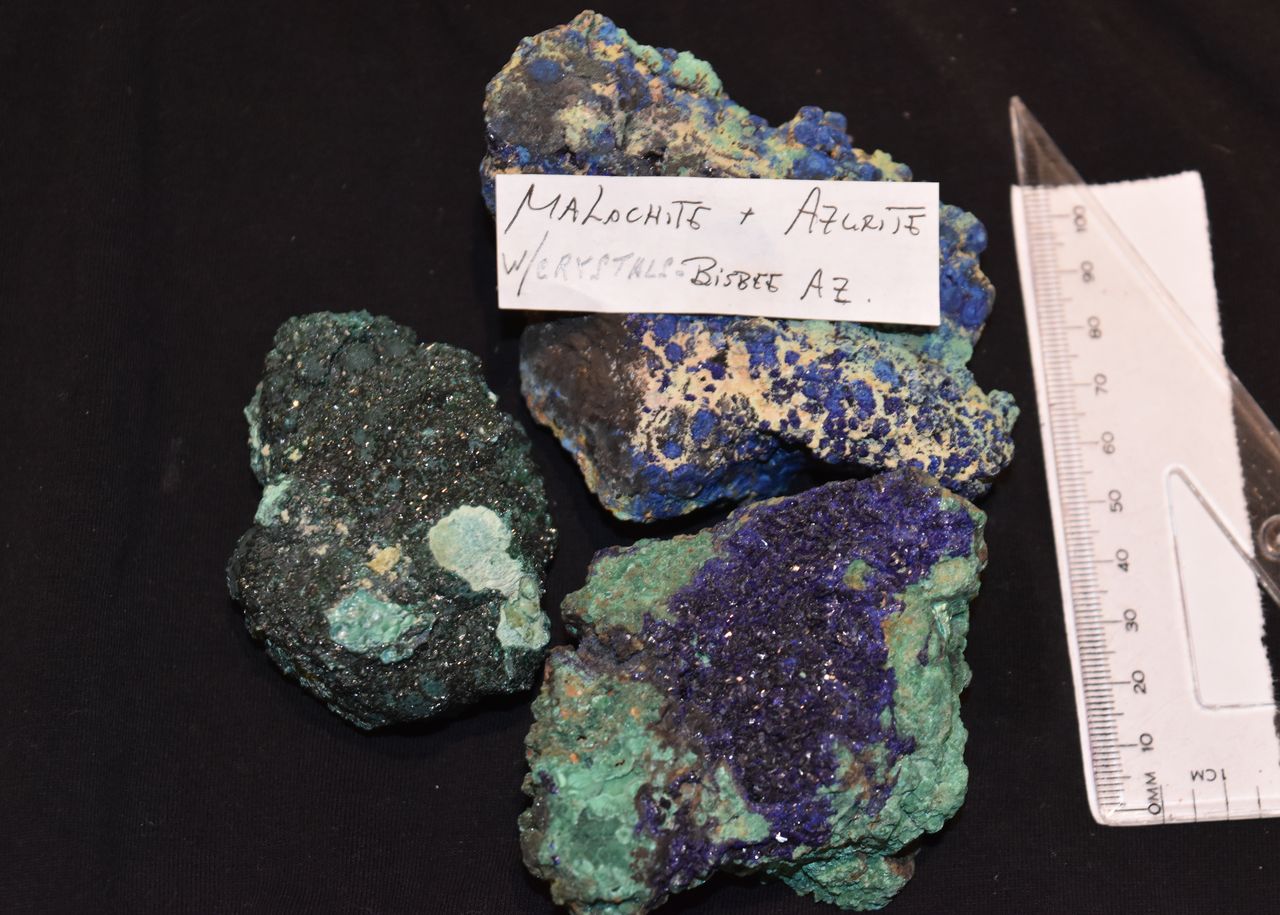
Three samples. Largest sample has Azurite with a vitreous lustre that is incrusting on grass-green Malachite.
*Missing, only one sample was measured.
Second largest sample has dark blue vitreous Azurite that is very small anhedral tabular crystals on top of grass-green dull Malachite that is incrusting in crystal habit.
The smallest sample is mostly dark green Malachite that is botryoidal in form and has an adamantine lustre.
Malachite (Cu2CO3(OH)2) can be emerald-green, grass-green or dark green in colour. Lustre is either adamantine, silky or dull and streak is light green. Hardness is 3 1/2 to 4 and cleavage is perfect crosswise. Malachite usually occurs as radial, fibrous, botryoidal, stalactitic, incrusting or earthy forms but can rarely occur as long or short prismatic crystals.
Azurite (Cu3(CO3)2(OH)2) can be azure-blue or dark blue in colour. Lustre is vitreous or dull and streak is blue. Hardness is 3 1/2 to 4. Cleavage is good in two directions. Azurite is usually found as tabular crystals or equidimensional crystals but can also be radiating, botryoidal, incrusting or earthy.
Specifications
| Object name | Malachite and Azurite |
|---|---|
| ID | UNB-2017-0165 |
| Legal status | Permanent collection |
| Category | Mineral |
| Classification | Mineral group: Carbonates |
| Composition |
|
| Origin | Bisbee, Arizona, U.S.A. |
| Pieces | 3 |
| Partial | No |
| Measurements |
|
Map of Origin
Publications
- Chesterman, C.W. 1979. Audubon Society, Field Guide to North American Rocks and Minerals. Knopf.